


Celtic Tattoo Sleeve for Men: Knotwork Fake Tattoo, 2 Weeks
 Celtic Tattoo Sleeve for Men: Knotwork Fake Tattoo, 2 Weeks
Lasts 10–14 days
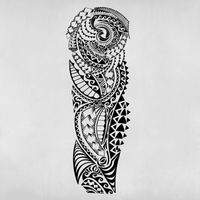
A Celtic tattoo is built on knotwork: lines that go over and under with no start and no end. People read it as eternity, bonds that never break and loyalty to their roots. On this sleeve, a knot medallion, a long band of knotwork and a triquetra cover the arm without one heavy central image.
At InkToday, this Celtic sleeve is 5.5 x 17.5 in and lasts 10–14 days, so you can wear it on your arm before you book a real tattoo.
Size: 5.5 x 17.5 in (13.9 x 44.5 cm sleeve) · Best placement: along the arm, starting at the wrist
See more sleeve tattoo ideas → · See more tattoo ideas for men →
What's in the kit?
Every InkToday tattoo ships in its protective sleeve, with an application guide to help you put it on.
How do I apply my tattoo?
Our tattoos are painless and very easy to apply yourself – it only takes a few simple steps.
Follow the application guide supplied with your tattoo, or watch our video tutorial here.
Once applied, the ink reacts with the proteins and the keratin in your skin, and darkens within 24 to 36 hours.
Your tattoo then stays visible for 10 to 14 days depending on where you apply it on your body, before fading away naturally.
Colour and appearance
Unlike most temporary tattoos, INKTODAY ink bonds to the surface of your skin instead of simply sitting on top of it.
Once applied, the ink reacts with the proteins and the keratin in your skin, and darkens within 24 to 36 hours.
The final result looks like a real tattoo, in a deep blue-black colour.
How long does the tattoo last?
INKTODAY tattoos are designed to fade within 10 to 14 days.
How long they last depends on where you apply them, on your daily activities and on how hydrated your skin is.
The ink fades gradually as your skin renews itself naturally.
Here is an estimate of how long they hold, area by area:
🦵 Leg: day 1 to 5 (very dark colour), then day 6 to 12 (colour fading).
🦶 Foot: day 1 to 8 (very dark colour), then day 9 to 14 (colour fading).
🦵 Knee: day 1 to 6 (very dark colour), then day 7 to 12 (colour fading).
💪 Forearm: day 1 to 6 (very dark colour), then day 7 to 12 (colour fading).
💪 Shoulder: day 1 to 7 (very dark colour), then day 8 to 14 (colour fading).
💪 Upper arm: day 1 to 7 (very dark colour), then day 8 to 14 (colour fading).
✋ Hand: day 1 to 4 (very dark colour), then day 5 to 8 (colour fading).
Custom tattoo with my own logo
Can’t find what you’re after among our 200+ designs?
Order your custom tattoo here 🖤
InkToday ink: how we designed it
We developed our InkToday formula drawing on the natural, ancestral practices of tribes who used plant sap to mark their skin.
Our unique formula lets our INKTODAY tattoos last longer while giving a deeper, blacker colour.
Water-resistant and incredibly realistic, our tattoos offer an authentic, long-lasting experience.
Discover our founders’ story and how InkToday ink was created here 👀
Shipping and returns
We ship to most countries worldwide, free above the amount shown in your cart.
All non-personalised orders can be returned within 14 days, as long as the tattoo’s individual packaging has not been opened, of course.
Why try it before the real one
- See if 5.5 x 17.5 in is the right length on your arm.
- Watch how the knotwork looks on your skin, day after day.
- Love it? Show it to your tattoo artist. Not sure? Try another design next month.
What a Celtic tattoo means
Celtic knotwork, with no start and no end, is often read as eternity and bonds that last. The triquetra, three linked arcs, adds an idea of trinity. Many people also wear it for Irish, Scottish or Breton roots.
How to apply
- Clean and dry the skin.
- Press the tattoo on firmly.
- Peel off the backing.
- Let it develop: the ink darkens over 24–36 hours.
InkToday makes plant-based semi-permanent tattoos that develop on the skin over 24–36 hours, look like real ink and last 10–14 days, so you can try a tattoo design before getting it for real.
Meaning
The best-known Celtic knots decorate insular manuscripts such as the Book of Kells and the Lindisfarne Gospels. The triquetra, three linked arcs, has been read as a symbol of the Holy Trinity and appears in Catholic iconography.
Sources: Wikipedia, article “Celtic knot” · Wikipedia, article “Triquetra”
Size and placement
Design size: 5.5 x 17.5 in (13.9 x 44.5 cm)
| Placement | How it looks at this size | Who it suits |
|---|---|---|
| Forearm and upper arm | Placed from the wrist, the sleeve runs past the elbow and reads as one piece | The guy who wants to see what a real sleeve looks like |
| Calf and thigh | Along the leg, the knotwork band follows the line of the muscle | The guy who would rather show it in shorts |
FAQ
What are the meanings and significance of Celtic knots?
Celtic knots are made of lines that weave over and under without ever ending, so most people read them as eternity, lasting love or the ties between people. The finest early examples come from manuscripts such as the Book of Kells. Specific meanings for each knot are often modern readings, so pick the one that speaks to you rather than a rule.
Can Christians wear Celtic knots?
Yes. Many of the most famous Celtic knots come from Christian books, such as the Book of Kells and the Lindisfarne Gospels, made by monks. The triquetra is often read as the Holy Trinity and appears in Catholic art. For many Christians of Irish or Scottish descent, a Celtic knot is a way to honor both their faith and their roots.
Did ancient Celts have tattoos?
Possibly, but the evidence is thin. Roman writers describe Britons and Picts marking or painting their bodies, and historians still debate whether that meant tattoos or body paint. No tattooed Celtic skin from that period has been found. The knotwork we call Celtic today mostly comes from later Christian manuscripts, not from the skin of Iron Age warriors.
Are Celtic knots Irish or Scottish?
Both, and more. Knotwork flourished in what is called insular art, made in Ireland, Scotland and northern England between roughly the 7th and 9th centuries. The Book of Kells is linked to Iona and Ireland, the Lindisfarne Gospels to Northumbria. Brittany, Wales and Cornwall also claim Celtic heritage, so the knot belongs to all of them.
Temporary tattoos everyone is talking about!










Our customers speak better than we do!

Our favorite reviews, based on 121 reviews


