


How long will a geometric temporary tattoo last on skin?
A geometric temporary tattoo made with plant-based ink stays sharp on skin for 10 to 14 days on average. The ink reacts with the keratin in your top skin layer, then fades naturally as your cells renew. No needle, no scab, no drama, just a clean minimalist design that quietly disappears.
The 10-to-14-day window depends on three things: where you place it, how you treat it, and your own skin turnover. Areas that rub against clothing or see a lot of water (hands, fingers, inner wrist) fade faster. Zones like the outer arm, back, or ribs hold linework longer because the skin renews more slowly there.
Aftercare makes the real difference. Keep the fresh design dry while the plant-based ink develops and darkens over 24 to 36 hours. After that, moisturize gently, skip harsh scrubs, and pat dry instead of rubbing. Chlorine, saltwater, and oily sunscreens are the biggest enemies of clean lines.
Interested in the science of skin adhesion? A geometric temporary tattoo sits in the outermost stratum corneum, the layer your skin renews continuously. That's why the same triangle on your forearm might last 14 days for you and 9 for your friend.
Tattoos are more mainstream than ever: 32% of U.S. adults report having at least one, and 22% have more than one, according to a 2023 Pew Research Center survey, 2023. Testing a design first is smart. For a deeper timeline breakdown, check how long temporary tattoos really last.
What are geometric tattoos called in the temporary version?
Depending on the shop, you'll see them called long-wear tattoos, plant-based transfers, or 2-week tattoos. InkToday's vegan, plant-based formula is different from jagua or henna ink and fades naturally in 10 to 14 days. The geometric family covers sacred geometry, dotwork, mandala patterns, and fine line style.
The vocabulary can feel messy, so here's a quick decoder. "Long-wear" usually means the ink reacts with keratin (like ours) instead of sitting on top like a decal. "Water transfer" or "sticker" often points to a shorter-lasting decal that peels off after a few days. "Plant-based ink" signals a vegan formula without PPD or black henna, safer for reactive skin.
Inside the geometric world, styles branch out. Sacred geometry leans on triangles, circles, and Platonic solids with symbolic weight. Dotwork builds shape and shading from thousands of tiny points. Mandala patterns spiral outward from a center, meditative and dense. Minimalist design keeps it to a few sharp lines, perfect for the wrist or behind the ear.
| Style | Look | Best placement |
|---|---|---|
| Sacred geometry | Symbolic shapes, sharp angles | Forearm, chest |
| Dotwork | Shaded points, soft depth | Shoulder, back |
| Mandala patterns | Radial, detailed | Thigh, ribs |
| Fine line style | Thin, delicate strokes | Wrist, ankle |
If you're still figuring out your aesthetic before you commit, this guide to temporary tattoo styles walks through every family. The label matters less than the ingredient list and the fade time.
Which geometric temporary tattoo looks the most realistic?
The most convincing ones use plant-based ink that develops a deep, dark tone over 24 to 36 hours, mimicking healed real ink. Look for crisp linework, dotwork shading, and a matte finish that sits inside the skin rather than shining on top. Fine line style geometric pieces fool people most often.
Realism comes down to three visible clues. First, the color: fresh temporary decals often look brown or orange, which reads fake instantly. A quality plant-based formula darkens gradually to a color close to healed tattoo pigment. Second, the finish: real ink is matte and lives under the skin's surface, so anything glossy or plasticky breaks the illusion.
Third, the linework. A crisp mandala or dotwork triangle with clean edges and consistent line weight passes the two-foot test easily. Blurry outlines or pixelated dots give the game away. Fine line style pieces work especially well because thin strokes forgive small skin variations.
Placement also sells the effect. Flat, low-movement zones (outer forearm, ribs, back of the shoulder) hold linework beautifully. Curved or high-flex areas can distort the design and expose it as a transfer.
A quick placement test matters too. Apply a small shape first, live with it for two days, then decide if you want a bigger piece in the same spot. This is the whole point of trying ink risk-free before booking a real appointment. Skip a proper placement test and you might commit to a chest mandala you'd never actually enjoy long-term.
Solid tattoo aftercare keeps the illusion alive: dry skin the first night, no scrubbing, gentle moisturizer, and cover it during long showers.
Geometry is easy to redraw, so designing your own is a short route to an exact shape.
Do geometric tattoo designs age well before they fade?
Yes, clean linework and dotwork age gracefully over the 10 to 14 day window because straight edges and dots fade evenly, while heavy black fills or gradient shading tend to blur first. A minimalist design keeps its shape almost intact until day nine or ten, then softens into a faded pencil-drawing look before disappearing.
Sacred geometry pieces have a real advantage here. Triangles, hexagons and mandala patterns rely on structure, not on saturation, so even a lighter tone still reads as the same shape. A crisp fine line style piece on day twelve looks like a healed real tattoo caught mid-fade, which is exactly what you want.
Heavier blackwork behaves differently. Solid fills lose their punch faster because the top layer of skin cycles out unevenly around joints and creases. A big filled square on the wrist will patch before a dotwork triangle on the same spot.
| Design element | Fade pattern | Ages well? |
|---|---|---|
| Fine linework | Even, softens gradually | Yes |
| Dotwork shading | Loses density evenly | Yes |
| Solid black fill | Patchy around creases | Average |
| Gradient blend | Blurs, loses definition | No |
Pick structure over saturation and the design stays convincing until the very last day.
How can you apply a geometric fake tattoo like a pro?
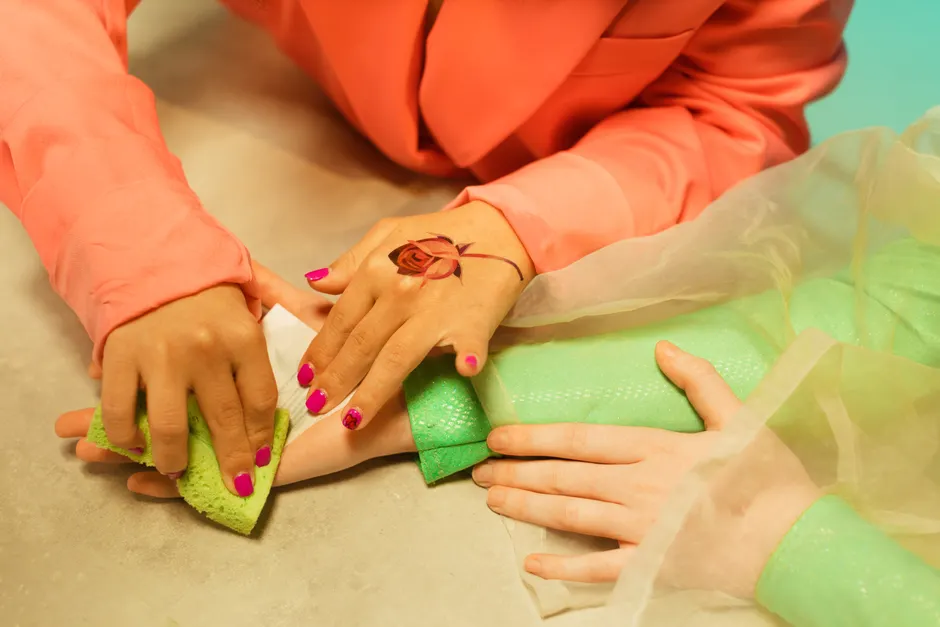
Clean the skin with soap, dry it fully, press the transfer face-down for 20 to 30 seconds with a damp cloth, then peel slowly. Let the plant-based ink develop for 24 to 36 hours before judging the color. Skip lotion, sweat and hot water during that window and the linework locks in sharp.
Prep decides everything. Any oil, sunscreen residue or moisturizer sabotages skin adhesion, and that shows up as broken lines or missing dots on a mandala. Soap and water on the exact spot is enough to degrease: avoid rubbing alcohol and acetone on this kind of formula.
Pick a flat zone with minimal stretch. Forearm, outer calf, ribs and shoulder blade give the sharpest results for a realistic geometric tattoo. Avoid knuckles and inner elbow unless you want the shape to warp on day two.
Do a placement test first. Cut a small triangle from the sheet, place it where you want the big piece, live with it for a day. If you still love it there, commit the full design. The transfer paper leaves a faint outline while the temporary geometric ink deepens underneath, so wait the full 24 to 36 hours before assuming the color looks off.
Frequently Asked Questions
What are geometric tattoos called in tattoo culture?
They fall under sacred geometry, blackwork or dotwork, depending on the technique. Sacred geometry covers mandalas, Platonic solids and flower-of-life patterns loaded with symbolism. Dotwork uses tiny dots to build shading and depth. Fine line style keeps everything thin and precise. On a single piece, artists usually blend these three approaches into one clean design.
What is the most realistic fake tattoo you can buy?
The most realistic fake tattoo uses plant-based ink that reacts with the top layer of skin instead of sitting on it. That reaction produces a matte, dark finish nearly identical to a healed real tattoo. Crisp linework, no plastic shine and a full 24 to 36 hour development window separate a convincing piece from a cheap decal that reads orange from day one.
Do triangles and mandalas carry specific meanings?
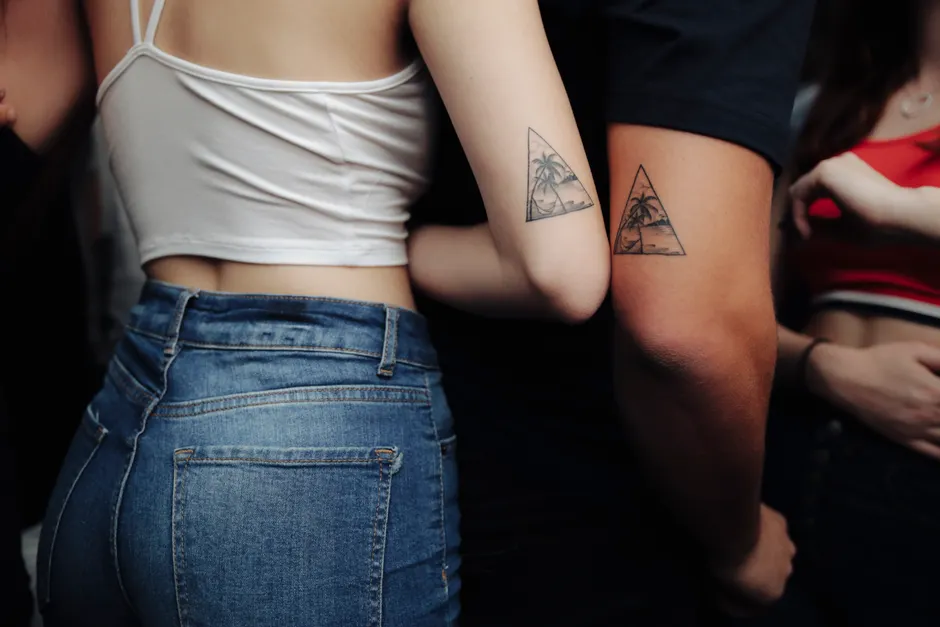
Triangles often represent balance, elements or trinity concepts across many cultures. Mandala patterns symbolize wholeness and cycles, borrowed from Buddhist and Hindu traditions. Hexagons reference harmony and structure, while Platonic solids tie back to classical philosophy. Picking a shape you connect with makes the placement test more meaningful, even before you go all-in on real ink.
Can I shower with a geometric temporary tattoo on?
Yes, short warm showers are fine once the ink has finished developing, after 24 to 36 hours. Avoid long hot baths, chlorine pools and aggressive scrubbing, which strip the ink faster. Pat dry, never rub. A light fragrance-free moisturizer twice a day keeps the linework from drying out and losing contrast before day ten.
Are plant-based tattoo inks safe for sensitive skin?
Plant-based formulas skip PPD and black henna, the usual culprits behind reactions (Source: FDA, Temporary Tattoos, Henna/Mehndi, and Black Henna, 2024). Sensitive skin still deserves a patch test: apply a small piece behind the ear or on the inner arm, wait 24 hours, check for redness. Kids and pregnant users should always check the full ingredient list first.
How do I remove a geometric design early if I change my mind?
Once the ink has developed, gentle exfoliation speeds things along. A sugar scrub, a loofah or a mix of baking soda and coconut oil lifts the top skin cells faster. Repeat morning and night. Complete removal usually takes several rounds; left alone, the design fades on its own across the full 10 to 14 days.
Clean lines, real symbolism and zero long-term commitment: that combo is exactly why a geometric temporary tattoo makes so much sense before booking any real appointment. InkToday keeps the formula plant-based, the linework crisp and the fade honest. Browse the full range on InkToday's geometric collection and test your placement risk-free.
Try it before the needle
These designs are in the InkToday catalogue, 10 € to 25 €, and they hold for ten to fourteen days. That is long enough to live with a placement before booking a needle. The last link takes your own artwork and prints it at the size you ask for.
 Deer tattoo in a geometric triangle10 €
 Large geometric lotus tattoo14 €
 Dog Paw Tattoo10 €
 Custom temporary tattoofrom 25 €
Clean geometry needs an ink that does not spread along the line. That is a property of the pigment, and the plant-based ink page explains which families hold a thin line.
Strip a geometric design back far enough and you arrive at the minimalist range. Our guide to minimalist temporary tattoos covers the smallest formats that still read at arm's length.
About InkToday
InkToday designs plant-based geometric tattoo pieces that develop into a strong dark color over 24 to 36 hours and hold their shape for up to two weeks. The vegan formula is dermatologically tested, from minimalist triangles to full mandala patterns. Explore the full guide to temporary tattoo aesthetics to find the style that matches your vibe before committing.