

Why did Inkbox shut down in 2026?
Inkbox shut down because BIC, the pen and razor maker that bought it, couldn't make the numbers work. BIC acquired Inkbox for $65 million in January 2022 (Source: BIC Corporate, "BIC Acquires Inkbox," 2022), then folded it into a "Skin Creative" division alongside Tattly. Sales and profitability declined after the deal, and BIC's leadership pulled the plug.
At acquisition, Inkbox was pitched as a fast-growing, direct-to-consumer brand with roughly $27 million in net sales and a proprietary jagua-based formula, in a DIY skin-creative market BIC projected to reach $1.5 billion by 2031 (Source: BIC Corporate, 2022). The bet was that a young, design-hungry audience would keep buying weekly drops and custom uploads at scale.
That bet didn't pay off inside a corporate structure built for razors and lighters, not a rotating catalog of artist collaborations. On December 4, 2025, BIC CEO Rob Versloot announced the company was winding down its entire Skin Creative division. That division covered the brand, Tattly, and the unrelated Rocketbook notebook line. Versloot said none of the three had delivered on sales and profitability expectations. Operations officially ended on February 23, 2026, with the last orders accepted the day before.
The DIY skin-creativity segment itself was never the problem. 32% of U.S. adults have a tattoo (Source: Pew Research Center, 2023). The combined market for permanent ink, temporary designs, and aftercare products is estimated at $8 billion (Source: CEW, "Painting Beauty's Next Opportunity: Body Art aka Skin Creativity," 2022). That number kept growing straight through the shutdown. The failure was a corporate-fit problem inside BIC, not proof that demand for testing a design before the needle disappeared. If anything, the shutdown news itself pushed more people to search for how the format works and where else to get it.
Is Inkbox back in 2026?
Yes. Inkbox is trading again: the store has been live since July 2026, under the Inkbox name and its "For Now Ink" formula (verified on inkbox.com, September 2026). Co-founders Tyler and Braden Handley had opened buyback talks with Jason Goldlist of Venue.ink after BIC's shutdown (Source: BetaKit, 2026).
The relaunched brand is still smaller than the one that shut down. Where the old catalog held more than 10,000 designs, the store now lists about 1,433 tattoo designs, priced from €8 to €33 depending on size (counted on inkbox.com, September 24, 2026). That is a supply chain and a design library rebuilt from close to zero in a few months, after a former parent that had walked away entirely. For the full 2026 relaunch timeline, see our Is Inkbox Back? guide.
For anyone who wants that exact plant-based skin stain, Inkbox takes orders again and its custom-tattoo tool is back online; what is still open-ended is the return of the full 10,000-design catalog. For anyone who just wants a reliable way to preview a tattoo design before a real appointment, that gap is exactly where an in-stock, full-catalog alternative like InkToday fits today, not in a few more months.
What's the real difference between Inkbox's "For Now Ink" and InkToday?
Inkbox's For Now Ink uses a patented Genipa (jagua) plant extract that oxidizes on the skin into a real stain lasting up to 10 days. InkToday uses a different plant-based mechanism: a water-transfer decal formulated to react with the surface layer of your skin (keratin), giving it the look of real ink for 10 to 14 days without jagua at all.
Both are honest, plant-derived ways to preview a design. Neither is a printed sticker that just sits on top of your skin and peels off in two days. Here's how the two actually compare on what matters if you're choosing between them right now:
| Criterion | Inkbox — For Now Ink | InkToday |
|---|---|---|
| Mechanism | Genipa (jagua) plant extract, skin-staining reaction | Water-transfer decal reacting with surface keratin |
| Duration | Up to 10 days | 10 to 14 days |
| Starting price | €8 | €8 |
| Catalog, mid-2026 | ~1,433 designs (Sept. 2026), rebuilt since July | Full catalog live now, plus custom uploads |
| Formula | Vegan, plant-based | 100% plant-derived, vegan, EU cosmetic-standard compliant |
If your priority is the exact jagua chemistry, Inkbox's relaunch is the direct match. If your priority is ordering today from a full, stable catalog with a custom-upload option already working, InkToday is the safer bet while Inkbox rebuilds.
Is a temporary tattoo sticker the same thing as a jagua stain?
No, and the difference matters. A basic printed decal sits on top of the skin and wears off in two to five days with no chemical reaction. A jagua or keratin-reactive product actually interacts with the outer skin layer, which is why it looks closer to real ink and lasts closer to two weeks instead of a weekend.
There are really three tiers on the market, and most articles blur them together. The cheapest tier is a plain ink-transfer sticker: fine for a festival weekend, gone in a few showers. The middle and top tiers both create an actual surface stain through a chemical reaction, they just use different plant compounds to do it, jagua-derived genipin on one side, InkToday's water-based decal reacting with surface keratin on the other. That's also why neither should be confused with black henna, which sometimes contains the allergen PPD and carries real documented reaction risk (Source: Clinical and Molecular Allergy, 2017). InkToday's ink contains no jagua and no PPD, and is formulated to EU cosmetic standards.
Whichever tier you pick, always patch-test a coin-sized dot on your inner arm 24 hours before applying a full design. No redness, no itching, no bumps: you're clear.
How do you test a design before booking a real tattoo?
Order the design in the size and placement you're actually considering, apply it with water, and live with it for the full cycle: shower, sleep, gym, sunscreen, all of it. If you still love it after a week or two, that's your answer for the tattoo artist. If you're over it by day four, you just avoided a permanent regret.
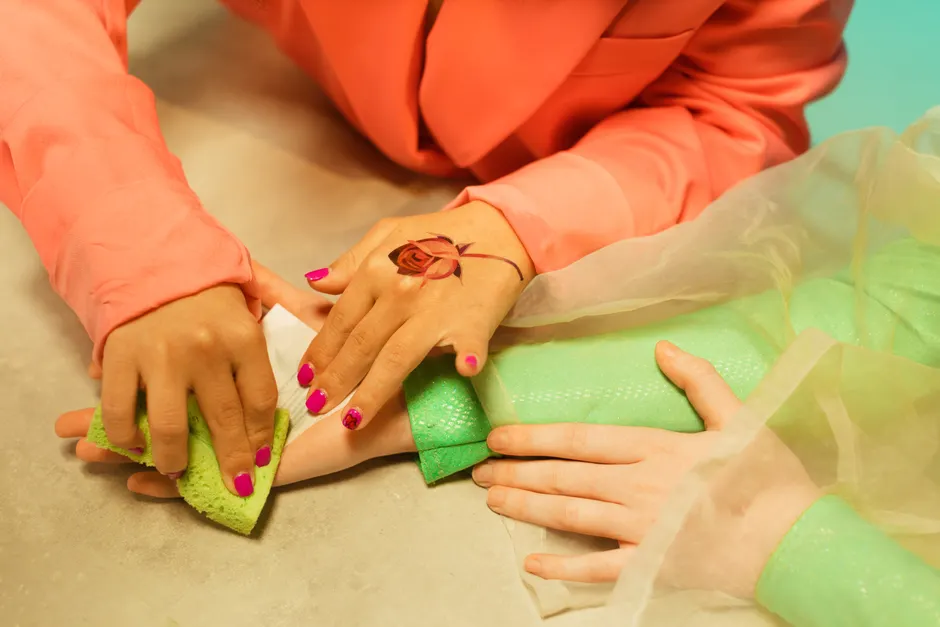
Pick a low-friction spot for your first trial. Forearm or wrist work best. Both have thinner skin, so the decal reacts faster and gives you a clearer read on the final look within a day. Skip the palm, the inner thigh, or anywhere clothing rubs constantly. Friction in those spots fades any temporary design faster and skews your read on how it actually holds up.
Take a photo on day one, day five, and day ten, in the same lighting each time. That side-by-side is far more useful than a single glance in the mirror, because fading is gradual and easy to miss day to day. Notice how it survives your actual routine, not a controlled test: gym sessions, hot showers, sunscreen, tight sleeves. If the design still reads clearly by the end of that stretch, you have a genuine answer on the placement and the size before you ever sit in a tattoo artist's chair. Our full guide to realistic temporary tattoos covers placement and aftercare in more depth.
Frequently Asked Questions
Why did Inkbox tattoos go out of business?
BIC bought Inkbox for $65 million in 2022, but sales and profitability declined once the brand was folded into BIC's corporate structure. On December 4, 2025, BIC announced it was shutting down its entire Skin Creative division, including Inkbox and Tattly, and operations ended on February 23, 2026.
Does Inkbox still exist in 2026?
Yes, under new independent ownership. After BIC's shutdown, original co-founders Tyler and Braden Handley pursued a buyback with Jason Goldlist and relaunched Inkbox in July 2026 under its own name, with a catalog of about 1,435 designs as of September 2026, still below the 10,000-plus it carried before the shutdown.
Who bought Inkbox back?
Original co-founders Tyler and Braden Handley, working with Jason Goldlist of Venue.ink, pursued the buyback from BIC after the shutdown was announced. The exact financial terms of the deal have not been made public.
Is InkToday the same jagua ink as Inkbox?
No. Inkbox's "For Now Ink" uses a Genipa (jagua) plant extract. InkToday uses a different, jagua-free plant-based formula: a water-transfer decal that reacts with the surface keratin of your skin. Both last roughly one to two weeks and both avoid henna and PPD, but the chemistry is not identical.
Is a plant-based temporary tattoo safe for sensitive skin?
Generally yes, but always patch-test 24 hours before applying a full design, regardless of the brand. If you've reacted to henna, fresh fruit, or fragranced skincare in the past, extend your patch-test window and check with a dermatologist before your first full application.
How long does InkToday last compared to Inkbox?
InkToday's decal lasts 10 to 14 days depending on placement and skin type. Inkbox's "For Now Ink" formula is marketed at up to 10 days. Both fall in the same realistic window, well beyond a basic printed sticker. Curious whether a 6-month claim is realistic for any brand? We break down the biology in our temporary tattoo 6 months guide.
The real story behind Inkbox's shutdown and comeback is a lesson in what a semi-permanent tattoo brand needs to get right: an honest wear time, a plant-based formula, and a catalog that's actually in stock when you want to order. InkToday was built around those same three things from day one, without a corporate parent to answer to. Browse the full semi-permanent tattoo collection and find a design to test for your next two weeks.
What to buy instead, today
Inkbox is no longer the default answer, so here is what InkToday sells most in its place. The three catalog designs below run 10 to 14 € and hold 10 to 14 days. If none of them fits, a custom temporary tattoo prints your own drawing or photo as the same transfer.
 Custom temporary tattoofrom 25 €
 Stem with wildflowers tattoo14 €
 Minimalist one-line heart tattoo10 €
 Minimalist one-line bee tattoo10 €
Can you still upload your own design to Inkbox in 2026?
Yes. As of 29 September 2026 Inkbox's custom builder is live on inkbox.com, listed as semi-permanent black line work with no minimum order, and every submitted design is reviewed by a human team against published content guidelines before it goes into production. Custom did not disappear with the 2026 shutdown.
This is worth stating plainly because a lot of pages written during the February 2026 closure still say custom uploads are gone. They were, for months. They are not now. What did change is the scope: the relaunched custom flow is black line only, so shading, grey wash and colour work are out, and the review step means a design can be declined - the published guidelines rule out racist imagery, threats, explicit content and unlicensed public figures, among others.
Where InkToday differs is not availability but the drawing. A custom order here is redrawn for line weight and contrast before printing, because a logo or a photo traced at original thickness reads as a smudge at 6 cm on skin. Pricing starts at 25 € for a single piece, there is no minimum quantity, and the ink is the same vegan plant-based formula as the catalogue designs, with the same 10-to-14-day claim. If you are weighing the two, our 2026 brand comparison sets out the formulas side by side, and the guide to designing your own walks through file preparation.
If what you lost when Inkbox closed was the custom builder, that is the part we replaced: order a custom temporary tattoo from 25 €, black line work redrawn for skin, no minimum quantity.
For the category itself rather than the brand, our semi-permanent tattoos page sets out what a topical semi-permanent ink does, what it costs and where it stops.
The specific questions people arrive with
Four different searches lead here, and each one has its own answer.
- Inkbox France closed - what changed for buyers shipping inside the EU
- Inkbox promo codes - what a discount code is worth against a lower list price
- Inkbox semi-permanent range - the closest equivalent formula and where it differs
About InkToday
InkToday designs plant-based, vegan temporary tattoos that react with the surface of your skin for a look closer to real ink, not a sticker. Every design lasts 10 to 14 days, is waterproof, and ships worldwide from €8, with a custom-upload option if you want your own artwork instead of the catalog. Read our full Inkbox alternative breakdown for the complete comparison.